Was The Annabelle Doll Really Possessed By A Spirit?
Was the Annabelle doll really possessed by a spirit? By Psychic Medium Kristian von Sponneck
Introduction: Is It All Just For The Big Screen?
The story of the Annabelle doll is one that refuses to fade. It has moved far beyond whispered legend and into mainstream popular culture, thanks in large part to Hollywood and the ever-growing fascination with the paranormal. But behind the dramatic music, the glass case warnings and the cinematic reimaginings lies a real case investigated by two of the most well-known paranormal investigators of the twentieth century, Ed Warren and Lorraine Warren. So the question remains: was the Annabelle doll really possessed by a spirit, or is this a story that has grown with time and imagination?
As a working Psychic Medium, I approach cases like this with both an open mind and a grounded perspective. I am not interested in sensationalism. I am interested in what is possible, what is probable and what is psychological. The Annabelle case sits right at the crossroads of all three.
The Original Annabelle – Not What You Think
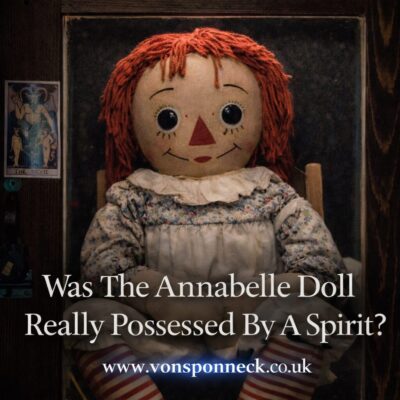
Most people picture Annabelle as the cracked porcelain doll with dark eyes and a sinister smile from the films within The Conjuring universe. In reality, the original Annabelle was a simple Raggedy Ann doll. Soft, fabric, red yarn hair, harmless in appearance. That difference alone tells you something about how storytelling evolves.
According to the Warrens, the doll was originally given to a nursing student named Donna in 1970. Donna lived with a roommate, Angie, and after bringing the doll into their apartment, they reportedly began to notice strange occurrences. The doll would change positions when they were not looking. It would appear in different rooms. Notes written on parchment paper saying “Help us” allegedly began appearing around the apartment, though neither woman owned parchment paper.
Eventually, a medium was invited to the apartment who claimed that the spirit of a young girl named Annabelle Higgins was attached to the doll. The story goes that the spirit was seeking love and acceptance and had attached herself to the doll as a vessel. The girls, feeling sympathy, allowed the spirit to “stay.”
This is where, from my professional standpoint, the case becomes interesting.
Attachment Or Permission?
In mediumship, there is an important distinction between spirit presence and attachment. Spirit presence is common. Many environments hold residual energy. People sense things, feel watched, dream vividly. That does not automatically mean possession or malevolence.
Attachment, however, implies permission or vulnerability. If we take the Warrens’ account at face value, the moment the girls emotionally agreed to allow the spirit to stay was pivotal. In psychic work, intention matters. Consent matters. When someone opens themselves emotionally to something unknown, they may unknowingly strengthen an energetic link.
The Warrens later claimed that the entity was not a little girl at all, but an inhuman demonic spirit manipulating the situation to gain trust. They removed the doll and placed it in their occult museum, where it remained in a glass case with a warning sign that read “Positively Do Not Open.”
Now, this escalation from child spirit to demonic entity is a significant leap. As someone who has conducted countless readings and investigations, I am cautious when narratives move quickly toward the demonic explanation. It is not that darker energies do not exist. It is that fear is a powerful amplifier.
Who Were The Warrens?
To understand the Annabelle case properly, we must understand the people behind it. Ed Warren described himself as a demonologist, though he had no formal theological qualifications in that field. Lorraine Warren claimed to be clairvoyant and often acted as the intuitive force during their investigations. Together, they founded the New England Society for Psychic Research in 1952, one of the oldest ghost hunting groups in the United States.
They investigated numerous high-profile hauntings, including the Perron family case that inspired The Conjuring and the infamous Amityville Horror. Over decades, they built both a devoted following and a significant number of critics. Skeptics accused them of exaggeration. Supporters believed they were bravely confronting genuine darkness.
The Warrens’ approach was deeply rooted in Catholic theology. Many of their cases framed phenomena as demonic infestation, oppression or possession. That framework shaped how they interpreted experiences. When you approach a case through a religious lens, you are more likely to interpret unusual activity as spiritual warfare rather than psychological or environmental factors.
This does not automatically make them wrong. But it does provide context.

The Psychology Of Haunted Objects
Objects can carry emotional significance. In psychometry, which I demonstrate during live shows, I hold an object and tune into the emotional imprint left behind by its owner. Objects absorb energy in a symbolic sense. They remind us of people. They trigger memory. They anchor emotion.
But can an object be possessed?
In my experience, spirits do not “live” inside dolls, mirrors or furniture in the way horror films portray. Energy can attach to a place. It can linger around objects associated with trauma or strong emotion. But true possession of an inanimate object is rare and would require extraordinary circumstances.
What is more common is projection. When fear builds in an environment, especially among young adults in a shared living space, small unexplained occurrences become magnified. A doll slightly moved could be misremembered. A note could be misinterpreted. Once a narrative is formed, confirmation bias does the rest.
That said, I do not dismiss the possibility that something was happening in that apartment. Two intelligent adults felt disturbed enough to seek help. That should not be ridiculed. But disturbance does not automatically equal demonic manipulation.
Hollywood Versus Reality
The transformation of Annabelle into a cinematic icon changed public perception dramatically. The version shown in Annabelle and its sequels is visually terrifying. The real Raggedy Ann doll is not.
Hollywood amplifies. It adds scratches, cracked porcelain, sinister smiles and dramatic backstories. It creates scenes of physical attack and violent movement that were never part of the original report. Over time, audiences forget which elements were original and which were invented for entertainment.
As someone who works both as a Psychic Medium and a performer, I understand the power of theatre. Atmosphere enhances experience. But theatre and truth are not the same thing.
The Warrens themselves were not strangers to media attention. They gave lectures, interviews and allowed filmmakers to adapt their cases. Public storytelling inevitably shapes memory. Every retelling adds colour.
Was It Really Possession?
Let us return to the core question. Was the Annabelle doll really possessed by a spirit?
If we define possession as a conscious non-human entity inhabiting and controlling a physical object with intent to cause harm, I would say there is no conclusive evidence to support that claim. There were no verified recordings of violent independent movement. No documented physical injuries conclusively linked to the doll. Much of the narrative relies on testimony.
If we define possession more loosely as an object associated with unsettling unexplained phenomena and possibly linked to spirit activity, then it becomes more plausible. It is possible that the apartment held residual energy. It is possible the girls’ belief amplified their experiences. It is possible that Lorraine Warren, being intuitive, genuinely felt something negative connected to the situation.
In mediumship, perception is filtered through belief systems. A Catholic demonologist will interpret through theology. A psychologist through trauma. A sceptic through rational explanation. A medium through energetic sensitivity.
The Annabelle case sits in the space between these interpretations.
Fear As An Energy Source
One aspect that rarely gets discussed properly is the role of fear. Fear is not just an emotion; it is energy. When people become afraid, they heighten their senses. They misinterpret shadows. They react more intensely to normal sounds. Fear feeds narrative.
If a spirit were seeking attention, fear would be a powerful amplifier. But equally, if nothing paranormal were occurring, fear alone could create the perception that something is.
The warning sign on the glass case in the Warrens’ museum added to that energy. “Do Not Open.” That phrase alone triggers imagination. It creates tension. Visitors project their own expectations onto the doll. That does not make them foolish. It makes them human.
My Professional View
From my own perspective, based on years of working without reliance on spirit guides and relying purely on my own senses, I lean toward the Annabelle case being a mixture of genuine unease, amplified belief and religious interpretation. I do not believe a child’s spirit was trapped in the doll. Nor am I convinced a demonic entity was orchestrating events.
I believe something may have unsettled those young women. I believe the Warrens interpreted it through their framework. I believe the story grew. And I believe Hollywood transformed it into legend.
As mediums, we have a responsibility not to escalate fear unnecessarily. We also have a responsibility not to dismiss people’s experiences outright. The balance is crucial.
Why The Story Endures
Annabelle endures because she represents something deeply symbolic. A child’s toy associated with danger challenges our sense of safety. It disturbs innocence. It makes the familiar unfamiliar. That psychological twist is powerful.
Add to that the authority of the Warrens, the growth of paranormal media and the success of the Conjuring franchise, and you have a story that will likely never disappear.
But enduring does not mean proven.
Conclusion: Storytelling And Media Combined
Was the Annabelle doll really possessed by a spirit? In my view, there is no solid evidence to confirm true possession in the dramatic sense presented by popular culture. There may have been unexplained activity. There may have been heightened emotion and belief. There may even have been spiritual energy in the environment. But possession of a doll by a demonic entity remains unproven.
The Annabelle case is a fascinating example of how belief, fear, religion, storytelling and media combine to create legend. It reminds us that in the world of mediumship and the paranormal, discernment is just as important as openness.
As always, my role as a Psychic Medium is not to sensationalise but to explore honestly. The unknown deserves curiosity, not hysteria. And sometimes, the most powerful force in any haunted story is not the spirit itself, but the human imagination surrounding it.
You may like my last post, click the following to read Are Spiritualist Church Mediums better than other Mediums?