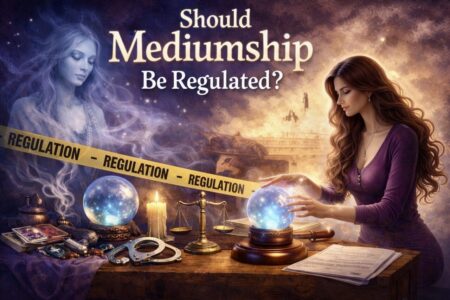
Should Mediumship Be Regulated?
Should mediumship be regulated? By Psychic Medium Kristian von Sponneck
Introduction: No Simple Answer
This is a question that comes up more and more often, particularly as mediumship becomes more visible through social media, television, and online platforms. Opinions are usually strong, and rarely balanced. Some argue that regulation would protect the public. Others believe regulation would damage the very essence of mediumship.
As a Psychic Medium, I think this is a discussion worth having properly, without emotional reaction or fear-based thinking. There is no simple yes or no answer, and much depends on what people believe regulation would actually achieve.
Why The Question Of Regulation Exists
The call for regulation usually comes from concern. There are people operating under the title of Psychic Medium who lack ability, integrity, or responsibility. This can lead to emotional harm, misinformation, and exploitation, particularly when vulnerable individuals are involved.
When people witness poor practice, the natural response is to ask for rules, oversight, and accountability. In principle, that is understandable. Any field involving emotional or psychological impact deserves scrutiny.
However, identifying a problem does not automatically mean regulation is the solution.
What Regulation Might Look Like In Theory
Those in favour of regulation often imagine a system of standards, training, and ethical guidelines. In theory, this could help differentiate responsible practitioners from those who should not be working with the public.
The difficulty lies in defining what would actually be regulated. Mediumship is not a mechanical skill. It cannot be measured, tested, or verified in the same way as a trade or profession. Any regulatory body would need to decide who qualifies as a Psychic Medium, who does not, and based on what criteria.
That is where theory begins to break down.
The Problem With Defining Mediumship
Mediumship is a subjective experience. Awareness, perception, and sensitivity do not present in a uniform way. No two mediums work identically, and no single belief system defines the work.
As someone who does not work with a guide and relies purely on direct awareness through the clair senses, I already sit outside many traditional frameworks. Under a regulatory model built on specific beliefs or practices, mediums like myself could easily be excluded despite working responsibly.
Regulation risks enforcing conformity rather than integrity.

Who Would Regulate The Regulators?
Another critical issue is authority. Who decides who is fit to regulate mediumship? On what basis would they claim expertise or legitimacy?
Historically, organisations formed to oversee mediumship have often been driven by belief systems rather than evidence. This can lead to gatekeeping, politics, and power dynamics that have little to do with genuine ability or public protection.
Regulation can quickly become about control rather than care.
Ethics Versus Regulation
Ethics and regulation are not the same thing. Ethical practice comes from self-awareness, responsibility, and accountability, not from certificates or memberships.
A Psychic Medium can follow every rule and still cause harm. Another can work without affiliation and act with deep integrity. Regulation does not guarantee ethics, and lack of regulation does not automatically mean recklessness.
What matters most is how the work is approached, not who signs it off.
The Risk Of False Security
One of the greatest dangers of regulation is the false sense of security it can give the public. When something is regulated, people often assume it is safe, vetted, and reliable.
In mediumship, this assumption can be misleading. A regulated title does not guarantee emotional intelligence, honesty, or competence. It can also discourage people from trusting their own judgement and discernment.
Public awareness and education are often more effective than regulation.
Personal Responsibility In Mediumship
From my perspective, responsibility sits with the individual medium. That responsibility includes knowing your limits, understanding the impact of your words, and being prepared to say no when appropriate.
Mediumship should never replace professional medical, psychological, or legal support. Recognising when someone needs help beyond mediumship is part of ethical practice.
No regulatory body can replace personal responsibility.
Conclusion: It’s Not Straightforward
So, should mediumship be regulated? In my view, regulation may appear attractive, but it is not a straightforward solution. Mediumship is too individual, too subjective, and too diverse to fit neatly into a regulatory framework without losing something essential.
The real issue is not the absence of regulation, but the absence of education, discernment, and accountability. Raising public awareness about what responsible mediumship looks like may do far more good than imposing rules that cannot truly measure the work.
As a Psychic Medium, I believe integrity, honesty, and self-awareness matter far more than regulation. Mediumship does not need controlling. It needs understanding, responsibility, and open conversation.
You may like my last post, click the following to read Does a Medium have a gift or an ability?